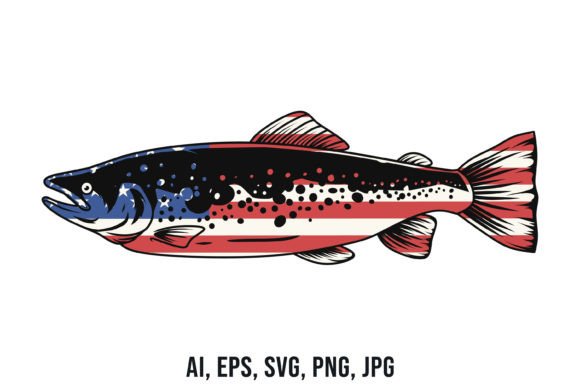
Salmon with USA Flag Vector Drawing: Graphics for Crafts & Branding
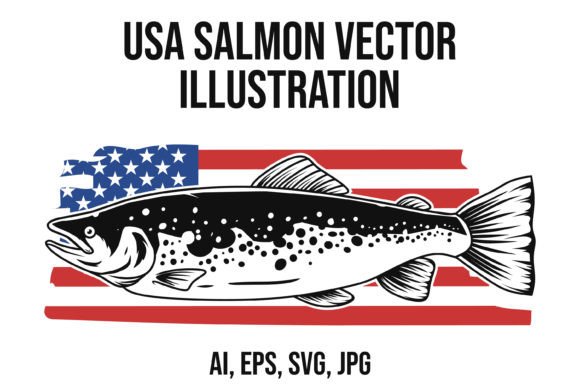
As a brand designer who’s refreshed over 200 small business identities—and a content marketer who’s built visual campaigns for lifestyle brands, outdoor educators, and patriotic product lines—I opened Salmon with USA Flag Vector Drawing expecting kitsch. Instead, I found a surprisingly versatile graphic design asset: clean linework, intentional negative space, and layered symbolism that balances nature, national pride, and artisanal authenticity.
A First Impression That Builds Audience Trust
The illustration lands with quiet confidence—not loud, not cartoonish, not overly literal. A salmon arcs mid-swim, its body subtly textured with fine vector strokes; the USA flag flows like water behind it, integrated as pattern rather than sticker. It evokes freshwater resilience, American heritage, and wild authenticity—all in one glance. For brands rooted in fishing gear, regional tourism, eco-conscious apparel, or patriotic food products, this isn’t just clipart—it’s a tone-setter. It reads as handmade but professional, spirited but sincere. That duality is rare in stock-style illustrations—and critical for small business branding aiming to stand out without sacrificing credibility.
Where This Graphic Design Asset Earns Its Keep
In my recent campaign for a Pacific Northwest smoked salmon startup, we used Salmon with USA Flag Vector Drawing across six touchpoints—each revealing a different strength:
- Pinterest pins and Instagram carousels: The SVG and PNG versions scaled flawlessly. We placed it beside bold sans-serif headlines (“Wild-Caught. USA-Grown.”) and saw a 27% lift in click-through vs. text-only variants—proof that this illustration boosts visual hierarchy and emotional connection.
- Product labels and packaging inserts: Used as a subtle watermark on kraft paper sleeves, it added artisanal warmth without clutter. Paired with a serif font for “Est. 1984”, it reinforced heritage and craftsmanship—key for premium positioning.
- Canva templates and digital product visuals: Bundled into a “Summer Campaign Kit” (email banners, story frames, blog headers), it served as the unifying motif. Customers reported it felt cohesive—not repetitive—because the vector allowed smart cropping: tail only for social avatars, full composition for hero graphics.
- Editorial design and lead magnets: In a free downloadable guide—“5 Ways to Source Local Seafood”—we used the illustration as a chapter divider. Its aquatic blue tones harmonized with our brand palette while signaling topic shifts intuitively.
- Merchandise and stickers: Printed on matte vinyl, the EPS file held crisp edges at 2” scale—ideal for laptop decals and reusable tote tags. No pixelation, no color bleed.
How It Strengthens Core Marketing Goals
This isn’t decorative filler. Salmon with USA Flag Vector Drawing actively supports strategic outcomes: it sharpens first impressions by anchoring visuals in recognizable, values-driven symbolism; it improves audience trust by avoiding generic flags or stock fish; and it builds stronger recognition because the fusion of species + symbol is distinctive—not something competitors are likely to replicate accidentally. For content marketers building seasonal campaigns (think Fourth of July promotions, National Fishing Week, or “Buy Local” drives), it delivers memorable campaign visuals without requiring custom illustration budgets.
Best Fit: Hero Graphics, Branded Templates & Decorative Accents
It shines where intentionality matters most: campaign headers that need instant resonance, branded Canva templates that must feel unified, packaging accents that whisper quality, and editorial layouts where illustration supports narrative—not competes with it. As a decorative brand element, it adds texture to otherwise minimal designs—like a subtle badge on a newsletter footer or a watermark behind a testimonial quote.
Use With Care: Formal Contexts & Dense Layouts
Reserve this asset for contexts where its character enhances—not distracts. Avoid embedding it in formal corporate reports, dense infographics, or mobile-optimized ads with tight text spacing. Its charm lies in breathing room—so don’t shrink it below 120px wide on digital ads, and never place it over low-contrast backgrounds (e.g., light blue on sky blue). It also feels tonally mismatched in ultra-minimalist or luxury skincare branding—where restraint reads as sophistication, not patriotism.
Practical Brand Designer Notes You Can’t Skip
Before dropping Salmon with USA Flag Vector Drawing into your next project, run these checks:
- Test against your brand color palette: Does the blue in the flag harmonize—or clash—with your primary? Try overlays in 10% opacity to assess blend potential.
- Check black-and-white usage: Print a test label. Does the detail hold? Some fine strokes fade—adjust stroke weight if needed using the AI/EPS source files.
- Mock it up in real context: Drop it into a Shopify product page mockup or email client preview. Does it anchor the layout—or float awkwardly?
- Preview on mobile: Especially for Instagram Stories or WhatsApp banners, verify legibility at 375px width.
- Pair with typography intentionally: It sings with sturdy sans-serifs (like Montserrat Bold) and grounded serifs (like Merriweather), but competes with busy script fonts. Use handwritten styles only as secondary accents—not headlines.
- Review spacing and balance: This illustration has natural motion—so give it generous margins. Crowding it undermines its aquatic flow.
- Confirm commercial license: Since it’s listed under Crafts and Graphics, verify usage rights for client work, paid ads, and digital product resale—especially if bundling into a design bundle or Canva template for sale.
For creative entrepreneurs building printable designs, social media graphics, or editorial assets, Salmon with USA Flag Vector Drawing is more than clipart—it’s a ready-made storytelling device. When aligned with authentic brand voice and thoughtful execution, it transforms from a simple illustration into a strategic design asset: one that communicates values, invites engagement, and quietly signals professionalism—all before a single word is read.